
Delta Encoding
When a tool is queried twice and the context pack changed only slightly between queries, retransmitting the full payload wastes tokens on content the LLM already has. Delta encoding sends only what changed.
The protocol
The consumer (LLM) sends back the pack_root from a prior response. The server compares it to the current result and returns one of three outcomes:
Consumer sends: pack_root=a1b2c3d4

Server checks:
  1. Same root?     → "unchanged pack_root=a1b2c3d4 symbols=N" (zero cost)
  2. Known prior?   → Delta payload (only added/removed)
  3. Unknown prior? → Full payload (fallback)
Delta format
GCF profile=graph tool=context_for_task delta=true base_root=a1b2c3 new_root=d4e5f6 tokens=30 savings=81%
## removed
fn github.com/org/repo/pkg.OldHandler
method github.com/org/repo/pkg.Server.Deprecated
## added
@0 fn github.com/org/repo/pkg.NewHandler 0.85 rwr 0
@1 fn github.com/org/repo/pkg.UpdatedAuth 0.79 lsp_resolved 1
## edges_removed
github.com/org/repo/pkg.Router -> github.com/org/repo/pkg.OldHandler calls
## edges_added
github.com/org/repo/pkg.Router -> github.com/org/repo/pkg.NewHandler calls
Sections
| Section | Content | Format |
|---|---|---|
## removed | Symbols in prior pack but not current | Short refs: {kind} {qname} |
## added | Symbols in current pack but not prior | Full node lines plus a trailing distance: @{id} {kind} {qname} {score} {prov} {distance} |
## edges_removed | Edges in prior but not current | {source} -> {target} {type} |
## edges_added | Edges in current but not prior | {source} -> {target} {type} |
Removed symbols use short references (kind + qualified name only) because the consumer already has the full declaration from the prior response. Added symbols use full declarations, including the trailing distance, because they're new: the flat ## added section has no distance-group headers, so the distance travels on the line itself, which the consumer needs to reconstruct the new snapshot and verify new_root (see pack_root below).
When to use delta
Delta encoding is most effective when:
- The user edits a file and re-queries (a few symbols shift in/out of relevance)
- Time passes and recency scores change (some symbols promote, others demote)
- A dependency is added/removed (edge topology shifts slightly)
Rule of thumb: if the delta is less than 60% of the full payload size, use delta. Otherwise, retransmit in full (the overhead of tracking the diff isn't worth it).
Implementation
from gcf import encode_delta, DeltaPayload, Symbol, Edge

delta = DeltaPayload(
    tool="context_for_task",
    base_root="a1b2c3",
    new_root="d4e5f6",
    removed=[
        Symbol(qualified_name="pkg.OldFunc", kind="function"),
    ],
    added=[
        Symbol(qualified_name="pkg.NewFunc", kind="function", score=0.85, provenance="rwr"),
    ],
    removed_edges=[
        Edge(source="pkg.Router", target="pkg.OldFunc", edge_type="calls"),
    ],
    added_edges=[
        Edge(source="pkg.Router", target="pkg.NewFunc", edge_type="calls"),
    ],
    delta_tokens=30,
    full_tokens=200,
)

print(encode_delta(delta))import { encodeDelta, type DeltaPayload } from '@blackwell-systems/gcf';
const delta: DeltaPayload = {
tool: 'context_for_task',
baseRoot: 'a1b2c3',
newRoot: 'd4e5f6',
removed: [{ qualifiedName: 'pkg.OldFunc', kind: 'function', score: 0, provenance: '', distance: 0 }],
added: [{ qualifiedName: 'pkg.NewFunc', kind: 'function', score: 0.85, provenance: 'rwr', distance: 0 }],
removedEdges: [{ source: 'pkg.Router', target: 'pkg.OldFunc', edgeType: 'calls' }],
addedEdges: [{ source: 'pkg.Router', target: 'pkg.NewFunc', edgeType: 'calls' }],
deltaTokens: 30,
fullTokens: 200,
};
console.log(encodeDelta(delta));delta := &gcf.DeltaPayload{
Tool: "context_for_task",
BaseRoot: "a1b2c3",
NewRoot: "d4e5f6",
Removed: []gcf.Symbol{{QualifiedName: "pkg.OldFunc", Kind: "function"}},
Added: []gcf.Symbol{{QualifiedName: "pkg.NewFunc", Kind: "function", Score: 0.85, Provenance: "rwr"}},
RemovedEdges: []gcf.Edge{{Source: "pkg.Router", Target: "pkg.OldFunc", EdgeType: "calls"}},
AddedEdges: []gcf.Edge{{Source: "pkg.Router", Target: "pkg.NewFunc", EdgeType: "calls"}},
DeltaTokens: 30,
FullTokens: 200,
}
fmt.Println(gcf.EncodeDelta(delta))Output:
GCF profile=graph tool=context_for_task delta=true base_root=a1b2c3 new_root=d4e5f6 tokens=30 savings=85%
## removed
fn pkg.OldFunc
## added
@0 fn pkg.NewFunc 0.85 rwr 0
## edges_removed
pkg.Router -> pkg.OldFunc calls
## edges_added
pkg.Router -> pkg.NewFunc calls
pack_root: how it works
The pack_root is a content-addressed hash (SHA-256) of the packed context. It's computed from the sorted set of symbol qualified names and edge tuples. Two identical context packs always produce the same hash regardless of when they were generated.
This means:
- If the user hasn't changed anything and re-queries, the root is unchanged (outcome 1: zero cost)
- If one file was edited, a few symbols shift, and the root changes slightly (outcome 2: delta)
- If the user switched branches entirely, the root is unrecognizable (outcome 3: full retransmit)
Verifying a delta
A delta is self-verifying. Its header carries base_root (the snapshot the delta applies to) and new_root (the snapshot it produces). A consumer applies the delta to its copy of the base, recomputes the pack_root of the result, and checks it against new_root:
- The recomputed root equals
new_root: the delta applied cleanly, and both sides now hold the same snapshot. - It does not: the consumer rejects the delta with
root_mismatchand requests a full payload.
A removal of a symbol that is not present, or an addition of one that already exists, is rejected as delta_invalid before the root is computed. Because pack_root hashes each symbol's distance, the graph delta's ## added lines carry a trailing distance field so the consumer can reconstruct the new snapshot exactly (SPEC Section 10.1, 10.4). Each SDK exposes this as decodeDelta plus verifyDelta for the graph profile, and verifyGenericDelta for the generic profile.
Generic profile delta (v3.3)
Delta is not graph-only. The generic profile supports the same keyed diff over any tabular set (SPEC Section 10a). One column is the identity key (@id in the field declaration, key=id in the header), and the delta carries ## added / ## changed / ## removed sections:
GCF profile=generic delta=true base_root=sha256:aaa9f2... new_root=sha256:bbb4c7... key=id
## added [1]{@id,total,status}
1004|75.00|pending
## changed [1]{@id,total,status}
1002|29.99|shipped
## removed [1]{@id}
1001
## changed replaces the whole row by identity (no field-level patch); ## removed carries identity values only. Set semantics apply: row order is not significant, so carry an explicit rank field if order matters. All six SDKs expose this through encodeGenericFull / diffGenericSets / encodeGenericDelta / verifyGenericDelta, plus a GenericDeltaSession producer helper that re-anchors on a tunable cadence. See the API reference and cheatsheet.
Measured savings
Benchmarked against a 100-symbol base topology across the full 42-tokenizer suite (every major model family: GPT, Llama, Gemma, Mistral, Qwen, DeepSeek, Phi, Falcon, Yi, StarCoder, and more), so the savings are not an artifact of one tokenizer.
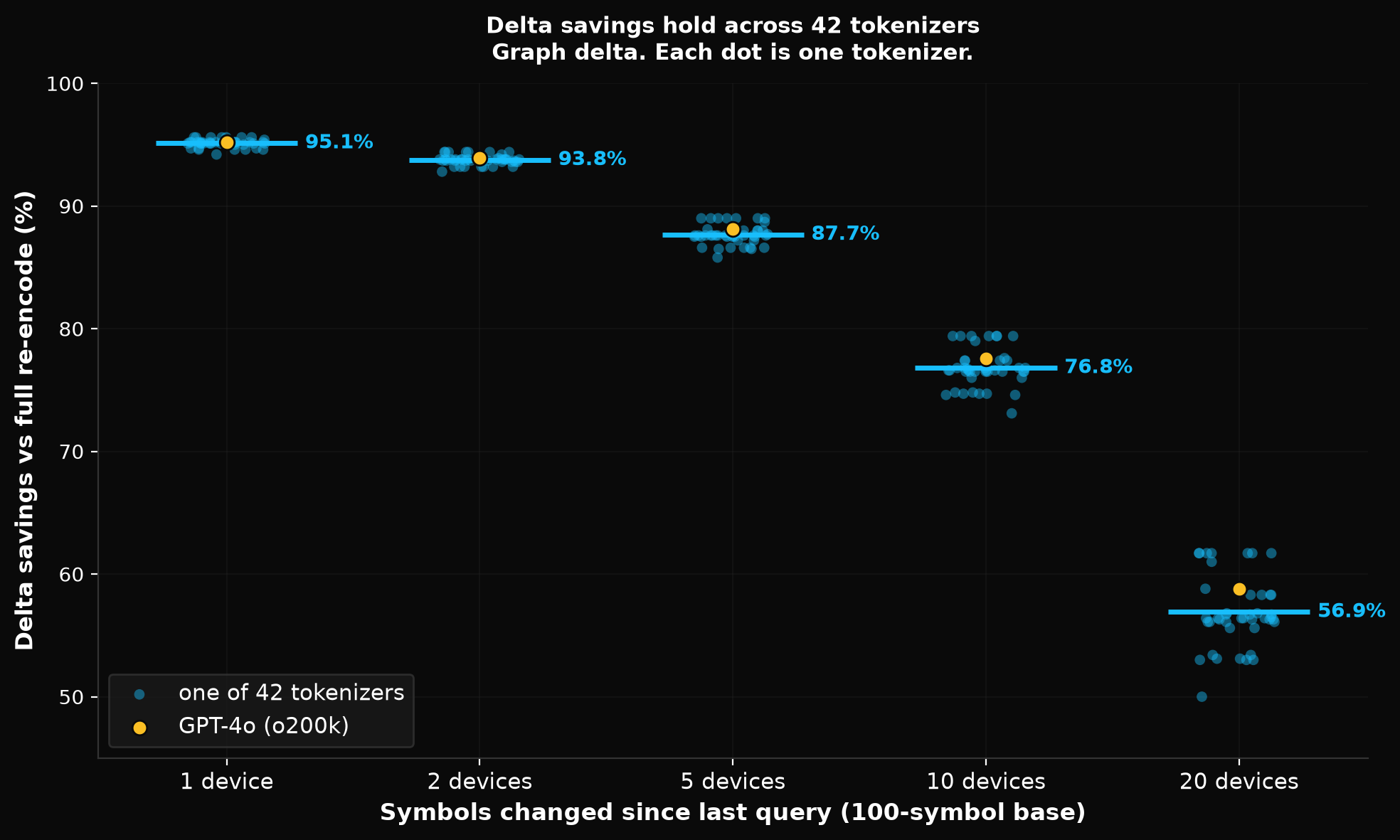
Representative token counts (GPT-4o o200k, 100-symbol base), with the delta savings range across all 42 tokenizers alongside:
| Change size | Full encode | Delta | Delta savings | Range across 42 tokenizers |
|---|---|---|---|---|
| 1 device | 2,327 | 112 | 95.2% | 94.2 - 95.6% |
| 2 devices | 2,326 | 143 | 93.9% | 92.8 - 94.4% |
| 5 devices | 2,325 | 277 | 88.1% | 85.8 - 89.0% |
| 10 devices | 2,327 | 521 | 77.6% | 73.1 - 79.4% |
| 20 devices | 2,329 | 960 | 58.8% | 50.0 - 61.7% |
For small topology changes (1-5 devices), delta saves 86-95% versus a full re-encode on every tokenizer tested. The spread across tokenizers is a fraction of a point for tiny changes and a few points at the largest.
Comprehension holds at depth
Delta saves tokens by never re-sending unchanged data. The obvious question: after dozens of deltas, does the model still track the current state, or does it drift? Measured, it holds.
A 50-turn stress test (a 50-row table, 5% churn per turn, six per-record state-tracking question types) found per-record retrieval essentially perfect: 1,777 of 1,777 correct, zero misses — every retrieval sub-type at 100% across weak-to-frontier models.
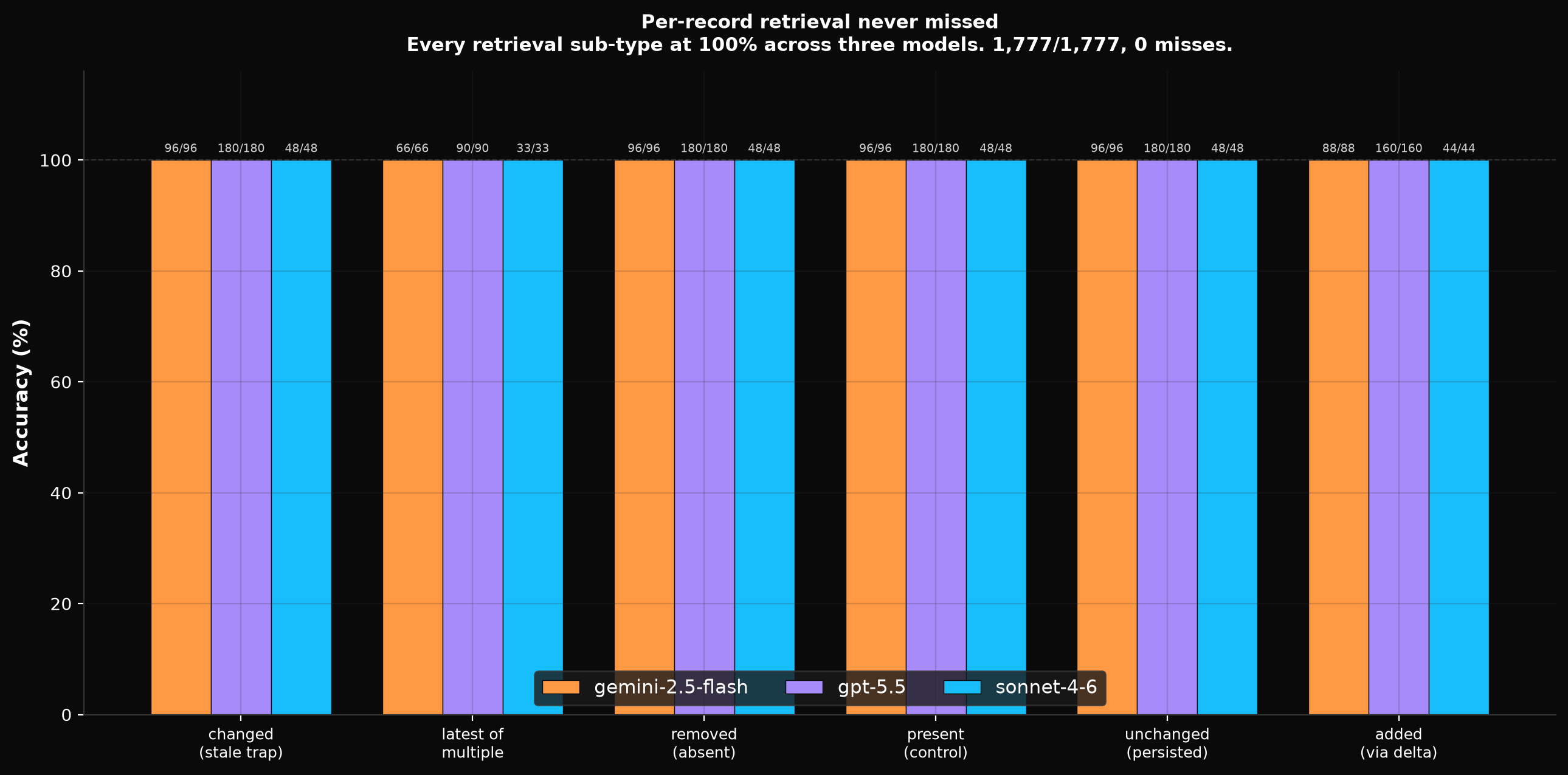
On frontier models it holds at 100% / 100% / 99% through all 50 turns (gpt-5.5, deepseek-v4-flash, gemini-2.5-flash). And against the send-everything-every-turn baseline, six of seven cleanly-measured models tie or beat a full re-send — at a fraction of the tokens.
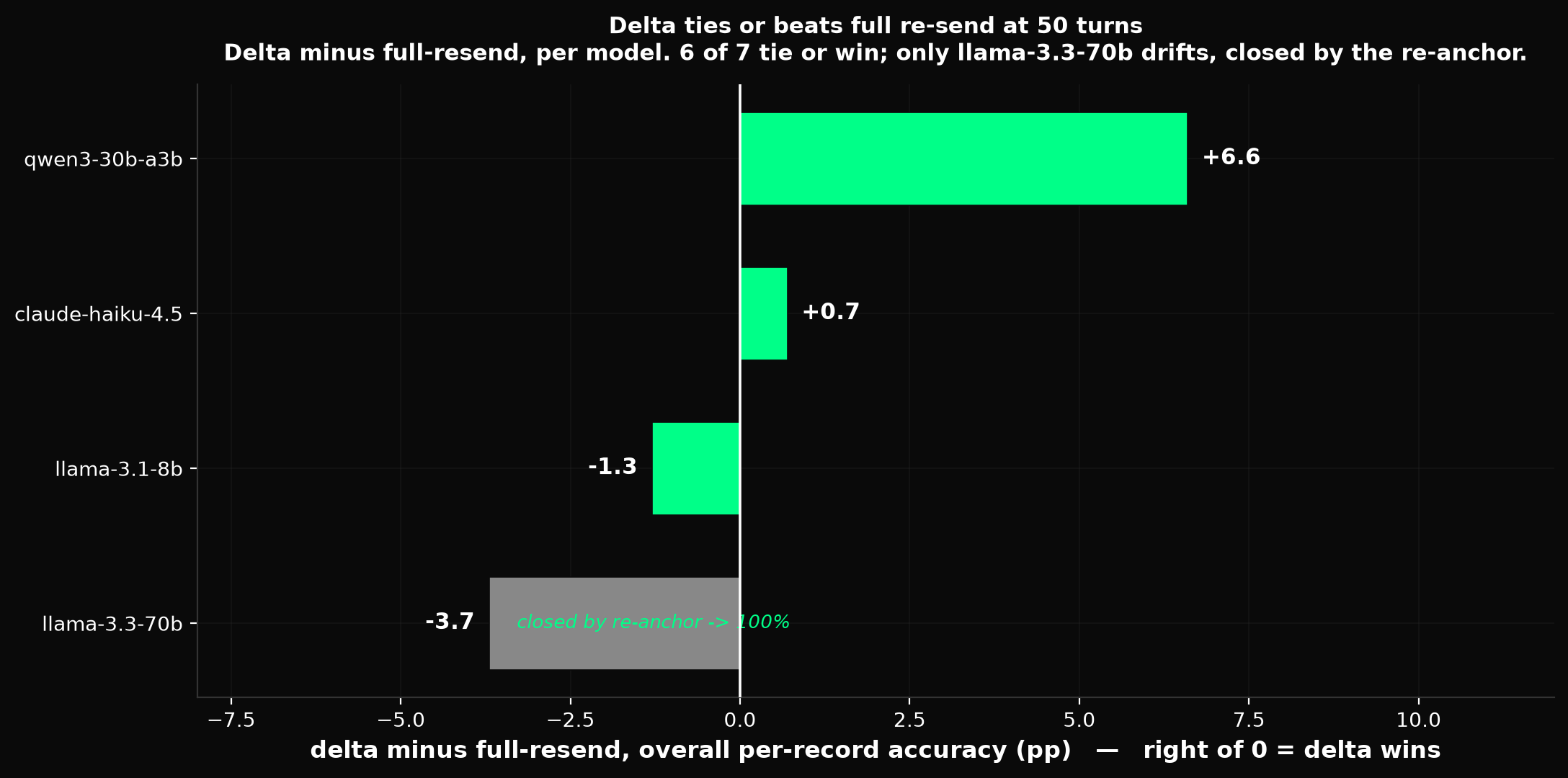
The one caveat, and its fix. A single model (llama-3.3-70b) drifts at the deep end (turns 41-50): a weaker model cannot always reconstruct current state from a long delta chain. The fix is a producer-side periodic re-anchor — re-send the full table every N turns (the "full" outcome of the three-outcome protocol, on a schedule; N=15 by default). It costs nothing on the wire, closes the drift back to 100%, and also rescues small and local models. The GenericDeltaSession helper applies it automatically.
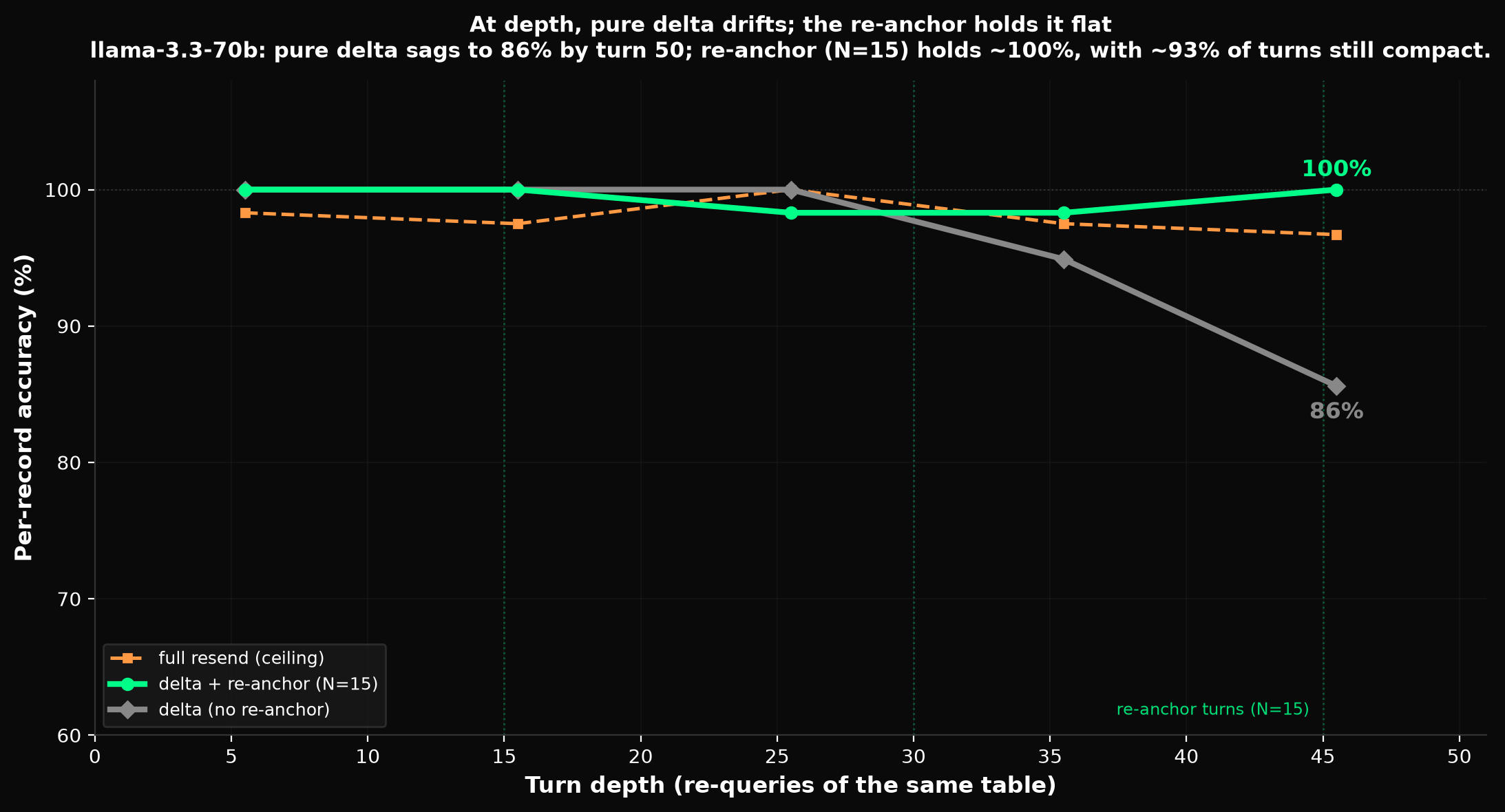
On llama-3.3-70b (the one drifting model), pure delta holds flat through turn 30, then sags to 86% by turn 50 (gray). A re-anchor every 15 turns holds it at ~100% deep (green), matching or beating full re-send (orange) while ~93% of turns stay compact deltas. N=10/15/20 all reach ~100%.
Delta is safe at depth by default, with a zero-cost lever for the models that need it. Full methodology and per-model results: DEPTH-FINDINGS.md.
Combining with session dedup
Delta and session dedup are orthogonal. An MCP server uses encode_with_session for the full payload on each call (bare refs for known symbols), and encode_delta when the topology changed slightly since the last call (only added/removed symbols). The session tracks cumulative state; the delta handles per-call diffs.
Combined savings (measured)
On a 10-call session with 500 symbols, measured across all 42 tokenizers:
| Encoding layer | Savings vs JSON (mean) | Range across 42 tokenizers |
|---|---|---|
| GCF format alone | 62.0% | 56.4 - 73.6% |
| + Session dedup | 83.2% | 80.0 - 89.8% |
| + Delta (stacked) | 93.0% | 91.9 - 94.9% |
Three layers compose: format savings, session dedup, and delta encoding each add independently measured improvements, and the stacked total holds 92-95% on every tokenizer. Representative token totals (GPT-4o): JSON 308,285 tokens over 10 calls collapse to 104,455 (format) to 49,211 (+dedup) to 19,238 (+delta).
Both tables reproduce with eval/delta-cross-tokenizer.py, which runs the identical scenarios as the session-savings harness across all 43 suite tokenizers (42 load in a stock checkout; the Claude tokenizer needs its npm package).