GCF vs TOON
GCF has two profiles. TOON has one. The comparison plays out on both dimensions, and GCF wins both.
On structured data (generic profile, the common case): GCF achieves 100% comprehension on every frontier model tested. TOON fails on GPT-5.5 and Gemini Flash. Both formats can encode flat tabular data, but GCF is 25.5% smaller across 15 real-world datasets. LLMs produce valid GCF at 5/5 on every frontier model. TOON's own decoder rejects LLM-generated output on 7 of 9 models.
On relationship data (graph profile): TOON has no grammar for this. No local IDs, no edge notation, no session dedup, no distance grouping. TOON must repeat full identifiers on every edge (~30-100 tokens each). GCF uses @0<@1 calls (~4 tokens). On 500-symbol code graphs, GCF scores 91.2% comprehension. TOON scores 68.2%. This isn't a gap that closes with optimization. TOON structurally cannot represent relationships efficiently without becoming a different format.
On TOON's own benchmark: We forked their benchmark, ran their original 6 datasets with their tokenizer and methodology, then added 9 more representing real-world MCP tool responses. GCF wins 13 of 15 overall. TOON's two wins total 104 tokens combined. GCF's 13 wins save 107,679 tokens.
Feature comparison
| Feature | GCF | TOON |
|---|---|---|
| Tabular encoding (arrays of objects) | Yes | Yes |
| Positional fields (no field names per row) | Yes | Yes |
| Pipe-separated rows | Yes | Comma-separated |
| Nested object encoding | ## key sections + key=value | Indented key: value |
| Semi-uniform data (optional fields) | Native (inline nested when present) | Falls back to less efficient encoding |
| Local IDs for cross-referencing | Yes (@0, @1) | No |
| Edge/relationship encoding | Yes (@0<@1 calls, ~4 tokens/edge) | No (must repeat full identifiers, ~100 tokens/edge) |
| Session deduplication | Yes (92.7% savings by 5th call) | No |
| Delta encoding | Yes (81.2% savings on re-queries) | No |
| Distance grouping | Yes (## targets, ## related) | No |
| Graph-native (nodes + edges) | Yes (graph profile) | No |
| Generic data (any JSON) | Yes (generic profile) | Yes |
| Streaming encode | Yes (true zero-buffering, O(1) memory, [?] + trailer) | Output-side only (requires full value in memory) |
| Key folding (dotted paths) | No | Yes |
| LLM comprehension (generic, 500 orders) | 100% on every frontier model | 92.3% (fails on GPT-5.5, Gemini Flash) |
| LLM comprehension (graph, 500 symbols) | 91.2% avg (24 runs, 10 models) | 68.2% avg |
| LLM generation (output tokens) | 75% fewer than JSON | 40% fewer than JSON |
| Human-readable | Dense, agent-optimized | YAML-like, human-friendly |
| Zero dependencies | Yes | Yes |
| Language support | Go, TypeScript, Python, Rust, Swift, Kotlin | TypeScript, Go |
| MCP proxy (zero-code adoption) | Yes | Yes ("Tooner") |
Where GCF wins
1. Token efficiency across 15 real-world datasets
15 datasets representing actual LLM tool response payloads. Same tokenizer (o200k_base), spec-compliant encoders:
| Dataset | GCF | TOON | GCF vs TOON |
|---|---|---|---|
| Event logs (semi-uniform) | 95,635 | 154,032 | -37.9% |
| E-commerce orders (nested) | 51,334 | 73,246 | -29.9% |
| Comprehension eval payload | 41,213 | 60,603 | -32.0% |
| Order history (shared schemas) | 13,295 | 16,454 | -19.2% |
| Blast radius response | 6,561 | 7,831 | -16.2% |
| Distributed trace | 4,318 | 4,959 | -12.9% |
| File tree + diagnostics | 6,018 | 6,894 | -12.7% |
| Analytics time-series | 8,404 | 9,127 | -7.9% |
| Employee records (flat) | 49,061 | 49,966 | -1.8% |
| GitHub repositories | 8,582 | 8,744 | -1.9% |
| PR file changes | 2,623 | 2,657 | -1.3% |
| Database query results | 17,716 | 17,969 | -1.4% |
| Multi-tool composite | 3,131 | 3,192 | -1.9% |
| Nested config | 645 | 618 | +4.4% |
| LSP symbol search | 5,442 | 5,365 | +1.4% |
| TOTAL | 313,978 | 421,657 | -25.5% |
GCF wins 13/15. Two marginal TOON wins: nested config (27 tokens, pure key-value tree with zero arrays) and LSP symbols (77 tokens, tokenizer artifact where | splits slightly worse than ,).
GCF's largest advantage is on semi-uniform and nested data (30-38% smaller) because GCF's inline schema optimization encodes nested objects positionally. TOON's tabular format requires all rows to have identical fields. When data is semi-uniform or has nested sub-objects, TOON falls back to its less efficient encoding.
Reproducible: blackwell-systems/toon-benchmark
2. Edge encoding (the structural advantage)
TOON has no concept of references between records. Every relationship must spell out the full identifier of both endpoints:
TOON edges (repeated identifiers):
edges[3]{source,target,type}:
  github.com/org/repo/pkg.NewServer,github.com/org/repo/pkg.AuthMiddleware,calls
  github.com/org/repo/pkg.AuthMiddleware,github.com/org/repo/pkg.ValidateToken,calls
  github.com/org/repo/pkg.ValidateToken,github.com/org/repo/internal.TokenCache,references
GCF edges (local IDs):
## edges [3]
@0<@3 calls
@1<@0 calls
@6<@1 references
Same information. GCF: ~4 tokens per edge. TOON: ~30-100 tokens per edge depending on identifier length. This advantage grows with longer qualified names (common in Java/Go packages) and higher edge density (call graphs, dependency graphs).
This is a structural limitation of TOON. It cannot be fixed without adding a local-ID system, which would make it a different format.
3. Session deduplication (TOON can't do this)
In multi-turn LLM interactions, the same data appears across multiple tool responses. GCF tracks what's been sent and replaces known records with bare references:
Call 1: full declarations
GCF profile=graph tool=context_for_task symbols=15 edges=10 session=true
## targets
@0 fn pkg.AuthMiddleware 0.78 lsp_resolved
@1 fn pkg.ValidateToken 0.72 lsp_resolved
...
Call 5: 92% bare references
GCF profile=graph tool=context_for_task symbols=22 edges=16 session=true
## targets
@0  # previously transmitted
@1  # previously transmitted
@2  # previously transmitted
@18 fn pkg.NewEndpoint 0.88 lsp_resolved
...| Call | New records | Bare refs | Savings vs JSON |
|---|---|---|---|
| 1 | 100% | 0% | 84% (base GCF) |
| 2 | 35% | 65% | 89% |
| 3 | 20% | 80% | 91% |
| 5 | 8% | 92% | 92.7% |
TOON retransmits every record every time. It has no session concept. By the 5th tool call in a conversation, GCF is using 92.7% fewer tokens than JSON while TOON is still at ~69%.
This isn't a feature that can be bolted on. Session dedup requires the format to support bare references (@N # previously transmitted), which requires local IDs (@N), which TOON doesn't have.
4. Delta encoding (TOON can't do this)
When the LLM re-queries and the data changed slightly, GCF sends only the diff:
GCF profile=graph tool=context_for_task delta=true base_root=aaa new_root=bbb savings=81%
## removed
fn pkg.OldHandler
## added
@0 fn pkg.NewHandler 0.85 rwr
## edges_removed
pkg.Router -> pkg.OldHandler calls
## edges_added
pkg.Router -> pkg.NewHandler calls
81.2% savings on re-queries in production. TOON must retransmit the entire payload even if one record changed.
5. Distance grouping (semantic structure)
GCF encodes how far each record is from the query center:
## targets       ← direct matches (distance 0)
@0 fn pkg.Auth 0.92 lsp
## related       ← one hop away (distance 1)
@3 fn pkg.Server 0.65 lsp
## extended      ← broader context (distance 2)
@6 type pkg.Cache 0.41 structural
The LLM immediately knows what's most relevant without scanning the entire payload. TOON encodes all records in a flat list with no semantic grouping.
LLM generation: TOON fails, GCF doesn't
28 generation runs across 9 models and 3 providers. Same data, same prompt structure, output validated through real decoders (including TOON's official toon-go library).
| Model | GCF | TOON | JSON |
|---|---|---|---|
| Claude Opus 4.6 | 5/5 | 0/5 | 5/5 |
| Claude Sonnet 4.6 | 5/5 | 2-3/5 | 5/5 |
| GPT-5.5 | 4-5/5 | 1-2/5 | 5/5 |
| GPT-5.4 | 5/5 | 0/5 | 5/5 |
| Gemini 2.5 Pro | 5/5 | 1/5 | 5/5 |
| Gemini 3.1 Pro | 5/5 | 0/5 | 5/5 |
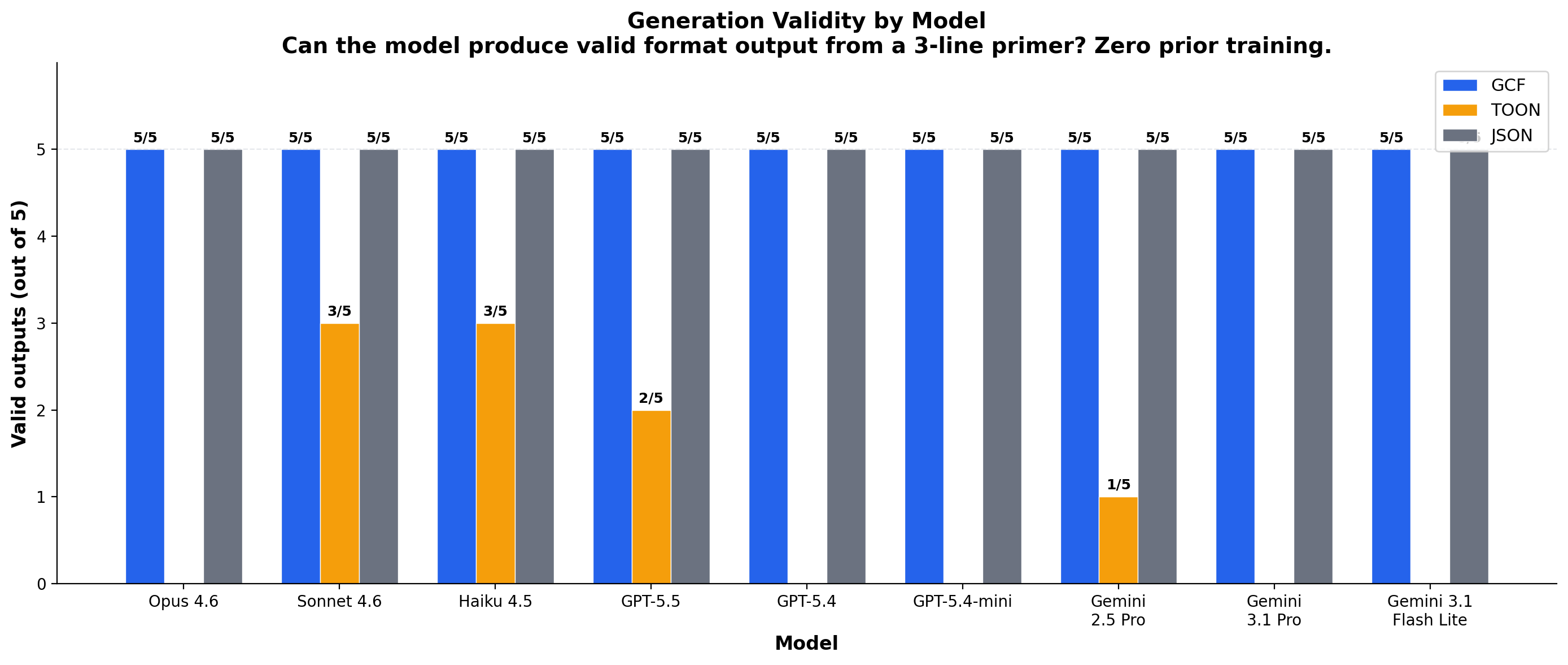
TOON's official decoder rejects the output on 7 of 9 models. The failure is structural: TOON's flat columns require the model to encode semantic categories as integers. When told "this symbol is a target," the model writes target in the distance column. TOON's decoder expects 0. Every model fails to perform this mapping unprompted.
GCF expresses distance through section placement (## targets, ## related). No integer mapping required. The format aligns with how LLMs naturally express grouped data.
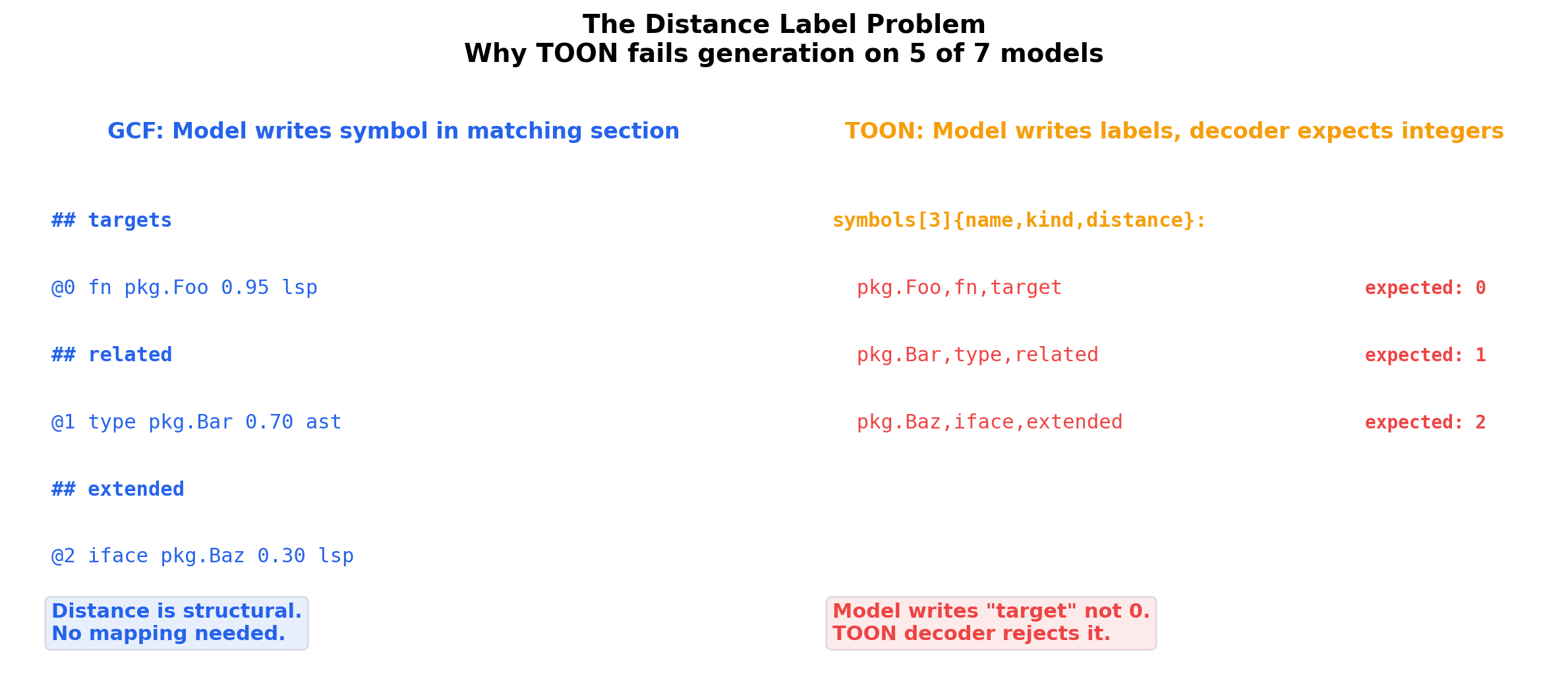
When TOON is given pre-encoded integers (hand-holding the model through the mapping to compensate for their fragile format), performance improves on some models but is still inconsistent. Even in the best case, TOON output is 28% larger than GCF.
GCF output is 63% smaller than JSON and 33% smaller than TOON at 100 symbols. See the full generation data for all runs.
TOON's comprehension benchmarks don't test at scale
TOON's retrieval accuracy benchmark uses datasets of 100 rows or fewer and reports a 1.4 percentage point accuracy improvement over JSON (76.4% vs 75.0%). At this scale, all formats perform similarly because JSON's structural noise hasn't yet overwhelmed the model's attention.
GCF's comprehension eval tests at two scales:
Generic profile (500 orders, nested data, 7 models):
| Format | Frontier models (6) | Weak models (1) |
|---|---|---|
| GCF | 100% | 69.2% |
| TOON | 92.3-100% | 69.2% |
| JSON | 76.9-100% | 61.5% |
GCF: 100% on every frontier model. TOON fails on GPT-5.5 (count_premium_customers). JSON fails on Gemini 2.5 Flash (3 questions wrong).
Graph profile (500 symbols + 200 edges, 10 models, 23 runs):
| Format | Avg accuracy | Tokens |
|---|---|---|
| GCF | 91.2% | 11,090 |
| TOON | 68.2% | 16,378 |
| JSON | 53.4% | 53,341 |
24 runs. GCF wins 23, ties 1, loses 0. The difference between formats is invisible at 100 rows and undeniable at 500.
Scale test (1000 orders): JSON doesn't fit in 200K context. TOON doesn't fit on Sonnet. GCF (47K tokens) is the only format that works.
TOON publishes zero multi-model comprehension data and zero generation validity data.
"But GCF isn't human-readable"
Neither is protobuf. Neither are HTTP headers. Readability is a last-mile rendering concern, not a wire format property.
The agent reads GCF (cheap, 50-69% fewer tokens than JSON in the context window), does its work, then calls decode() at the end if a human needs to see the result. The context window savings are already banked. The decode costs one function call.
TOON optimizes for the case where a human is scanning the raw wire format. GCF optimizes for the case where an agent is consuming it and a human can view the decoded output if they need to. The second case is the common case. The first case is debugging.
Where TOON wins
Two marginal cases out of 15 datasets:
Nested config (+27 tokens, 4.4%): A deeply nested key-value tree with zero arrays. TOON's YAML-like
key: valueindentation is slightly more compact than GCF's## key+key=valuefor pure config data. This structure almost never appears as an LLM tool response.LSP symbol search (+77 tokens, 1.4%): A flat tabular array where TOON's comma delimiter tokenizes slightly better than GCF's pipe delimiter. GCF is fewer bytes but more tokens due to how the tokenizer splits on
|vs,.
Neither case is significant in practice. The total difference is 104 tokens combined, while GCF saves 107,679 tokens across the other 13 datasets.
TOON's encodeLines() is output-side streaming only (the full value must be in memory before encoding starts). GCF's StreamEncoder is true input-side streaming with zero buffering and O(1) memory per row. See the streaming guide for the full comparison.
The bottom line
Tokenization: TOON's tab delimiter is worse than JSON's quote
We ran the same tokenizer analysis on TOON's grammar symbols. TOON uses tab characters as column delimiters. Tabs merge with adjacent content more aggressively than JSON's quotes:
| Format | Delimiter merge rate (1,344 checks) |
|---|---|
| TOON (tab) | 59.82% |
| JSON (quote) | 39.29% |
| GCF (pipe) | 0.00% |
GPT-4's vocabulary has 60 of 64 tested words as tab+letter entries (vs 15 quote+letter entries for JSON). Tab-separated data was so common in training corpora that the tokenizer absorbed tabs into adjacent words even more aggressively than quotes.
TOON's indentation also tokenizes inconsistently across models: the same 4-space indent produces 4 different tokenizations across 8 tokenizers. The model sees different nesting depth depending on which tokenizer processes it.
GCF's pipe-based delimiters have zero vocabulary merges with field names across all 8 tested tokenizers.
This matters for comprehension at scale: Ildiz et al. proved that self-attention weights tokens proportionally to their frequency in the sequence. When TOON's merged tab-field tokens account for 60%+ of the sequence, the attention budget is mathematically dominated by structural noise. See the full tokenizer analysis for how this compounds at 500+ rows.
GCF does everything TOON does, plus five things TOON structurally cannot add without becoming a different format:
- Local IDs and edge encoding (requires
@Nreferences) - Session deduplication (requires bare references, which require local IDs)
- Delta encoding (requires content-addressed identity)
- Distance grouping (requires semantic section headers)
- True streaming encode (requires deferred counts + trailer; TOON spec mandates upfront
[N])
On 15 real-world datasets, GCF wins 13. Overall: 25.5% fewer tokens.
The gap widens over time. First call: GCF saves 34% vs TOON. Fifth call: GCF saves 92.7% vs JSON while TOON is stuck at 69%. No format change can close that gap without adding session state, which requires local IDs, which requires a fundamental redesign.
TOON Is Not Lossless
TOON claims "deterministic, lossless round-trips" on their landing page. We tested it.
10 million random structured values encoded with @toon-format/toon (their official npm package), decoded back, and compared to the original.
| GCF | TOON | |
|---|---|---|
| Round-trips tested | 43,000,000,000+ | 10,000,000 |
| Success rate | 100% | 92.46% |
| Decode errors | 0 | 577,717 |
| Silent data corruption | 0 | 176,487 |
| Total failures | 0 | 754,204 |
7.54% of TOON round-trips fail. 176,487 of those are silent: the encode and decode both "succeed" but the output doesn't match the input. The data is quietly corrupted with no error.
What breaks TOON
TOON's encoder does not quote strings containing structural characters ([, ], {, }, :). The decoder then misparses those strings as format syntax.
Example (seed 132): the string "name[3]: a,b,c" is encoded as a bare value. The decoder sees name[3]: and interprets it as an inline array declaration, returning ["a","b","c"] instead of the original string. Silent corruption.
Example (seed 2780): the string "1x#[3tyevb6L][_:qE" causes a decode error because the decoder tries to parse [_ as an array bracket.
The test
The fuzz test generates random JSON values (objects, arrays, scalars, nested to depth 3-4) using a seeded PRNG. Values include strings with commas, brackets, braces, colons, newlines, tabs, unicode, and other characters that probe format boundary handling. Every test is deterministic and reproducible from its seed.
# Reproduce
git clone https://github.com/blackwell-systems/gcf
cd gcf/eval
npm install @toon-format/toon
node toon-fuzz.mjs 10000000
Full log: toon-fuzz-10M-2026-06-16.log
Why GCF doesn't have this problem
GCF's scalar grammar quotes any string that contains pipe (|), newline, or could be misinterpreted as a typed literal. The quoting rules are specified in the grammar and enforced by all 6 implementations. 43 billion round-trips across 5 formats with zero mismatches is the proof.
Try both formats in the playground with your own data.
Get started in 5 minutes with any of 6 languages.